Robert Lenkiewicz
Signed limited edition silkscreen
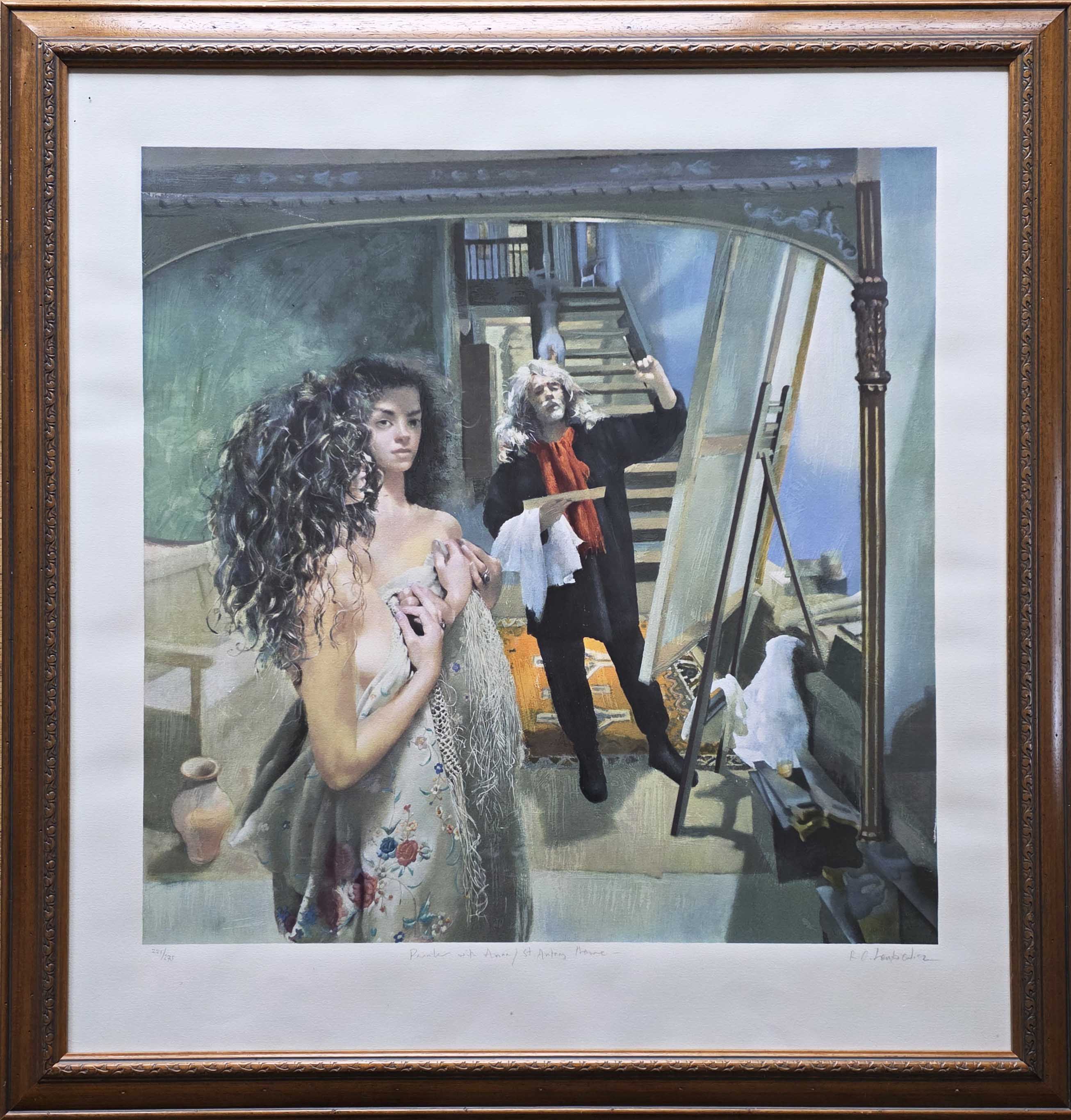
The Painter with Anna II
Signed, limited edition, silkscreen of 275
Published June 1994
Image size:- 28.75" x 28.75"
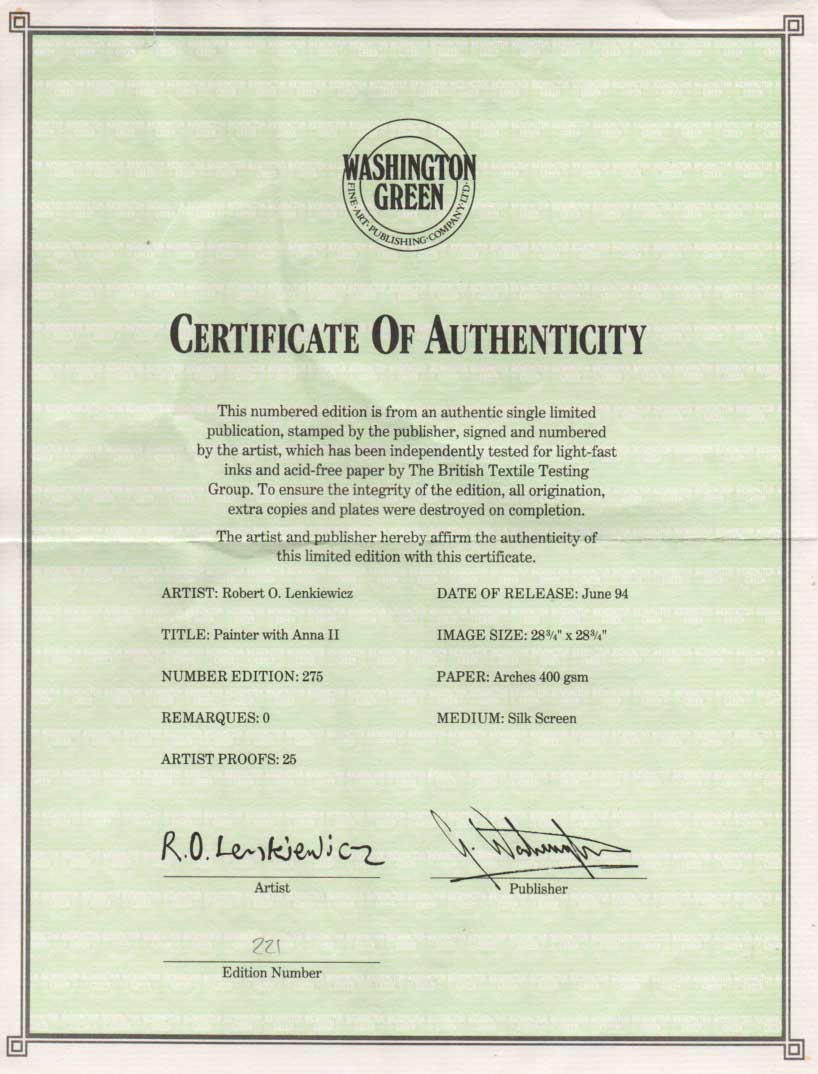
Robert Lenkiewicz
d@art.info
Telephone England 01623 799 309
The Sociological Painter: The Life and Legacy of Robert Lenkiewicz
Robert Lenkiewicz (1941–2002) was far more than an artist;
he was a self-described "sociological enquirer"
who used the medium of oil paint to document the human condition in its most raw, unfashionable, and often uncomfortable forms.
Born in London to Jewish refugees who ran a hostel for Holocaust survivors,
Lenkiewicz’s early exposure to the displaced and the traumatised deeply influenced his lifelong fascination with the "outsider".
The Philosophy of the Project
Unlike his contemporaries who leaned toward abstract expressionism, Lenkiewicz remained a steadfast figurative painter, heavily influenced by the Old Masters, particularly Rembrandt.
His work was organised into massive thematic "Projects"—comprehensive visual essays that combined hundreds of portraits with extensive sociological research and notes from his subjects.
These Projects tackled subjects that the art establishment often avoided:
Vagrancy (1973): His first major breakthrough involved living with and providing shelter for hundreds of homeless people in Plymouth,
whom he depicted with profound dignity and stark realism.
The Problem of Mortality:
A trilogy of investigations into Old Age (1979), Suicide (1980), and Death (1982) explored the isolation of existence. Lenkiewicz famously stated,
"You're born alone and you die alone," and his work was an attempt to confront that inherent loneliness.
Education (1988):
A scathing critique of the school system, which he described as the "mass spiritual slaughter of the young".
Controversy and the Barbican
Lenkiewicz’s life in Plymouth was defined by his refusal to "play the game" of the London art world.
He famously faked his own death in 1981 to see how his work would be received posthumously, and to observe the reactions of the public.
His most notorious act, however, was the embalming of Edward McKenzie (known as "Diogenes"), a homeless man with whom Lenkiewicz had a deep friendship.
He kept McKenzie’s body in his library for years as a memento mori, a physical extension of his enquiry into death.
Despite these scandals, his local impact was undeniable.
He painted the massive Barbican Mural (0.5.26), a 3,000-square-foot masterpiece depicting the Elizabethan history of Plymouth, infused with his personal interests in alchemy and metaphysics.
A Legacy of Humanity
Lenkiewicz was a "gentle giant" who preferred the opinion of the "man in the street" over the art critic.
He amassed one of the finest private libraries in Europe, dedicated to theology, philosophy, and the occult, believing that an artist must be as much a thinker as a craftsman.
Today, his work is increasingly recognised for its technical brilliance and its uncompromising empathy.
By choosing subjects who were invisible to society, the addict, the mentally ill, and the elderly; Robert Lenkiewicz did more than paint;
he forced us to look at the parts of ourselves we would rather ignore.