Figures on a beach
L.S. Lowry
R.B.A., R.A.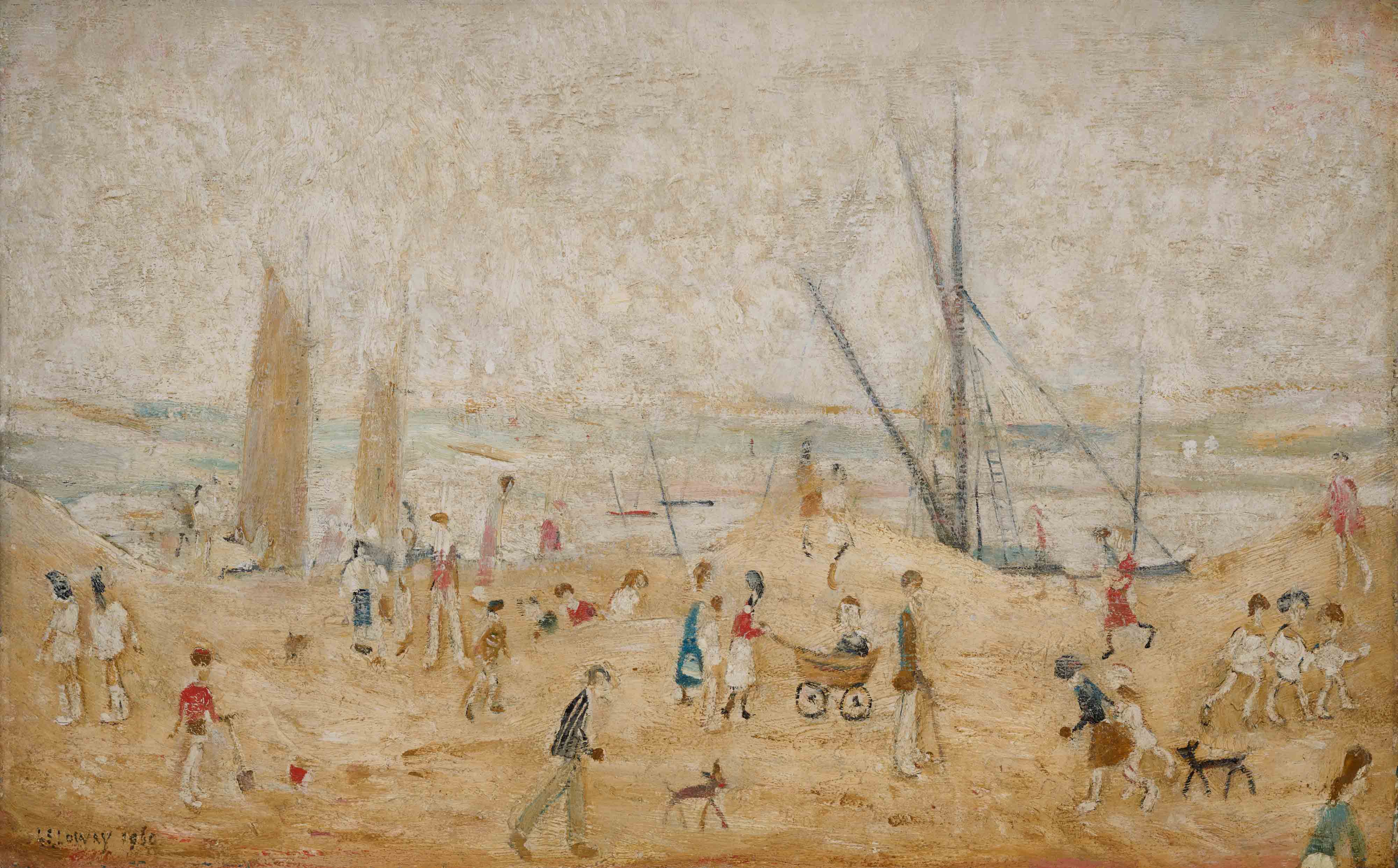
FIGURES ON A BEACH
signed and dated L S Lowry 1960 lower left
oil on canvasboard
38 x 60cm; 15 x 23 1/2in
55 x 77cm; 21 3/4 x 30 1/4in (framed)
Property from a Private Collection, Kent
Provenance
Monty Bloom, Southport (acquired from the artist)
Sale, Christie's London, 21st November 1969, lot 56 (titled Beach scene)
Ronald Lyon, Wentworth (purchased at the above sale)
Sale, Christie's London, 15th March 1985, lot 267
Purchased by the uncle of the present owner circa 2000
Lowry's Figures on a beach brilliantly captures the variety of activities of day trippers and holiday makers young and old at play, in conversation or immersed in their thoughts as they walk or run across the sands.
The holiday setting and carefree mood is far removed from the artist's typical depictions of life in the city.
In the foreground a man in a stripey blue blazer walks his dog. Nearby another man in white flannel trousers pauses, his walking stick dug into the ground,
as he surveys the children approaching him with their dog and the trio of three girls in white dresses that walk away from him.
Between the two men a woman with her son pushes a child in a pram as she talks to her friend in a green dress.
To the right a mother in red hurries across the beach carrying her baby.
Behind them parents watch as children play: amongst them three bury themselves in the sand, a boy digs with a spade and two girls in white dresses walk off the scene.
As Michael Howard comments, in such beach scenes Lowry 'celebrates the restrained, puritanical pleasures of doing nothing,
or the banal activities that mask the private pleasures of observation and contemplation' (Michael Howard, Lowry A Visionary Artist, Salford, 2000, p. 231).
The inconsequential, humdrum activities of young and old together on a beach is underlined by the soft touch of Lowry's brush.
The light colouring of the sand, sea and sky almost merge into one, the figures are similarly muted with just a few of their clothes picked out in red, blue and green, or distinguished by the colour of their hair.
Likewise, the pastel hues of the masts and sails that give a vertical structure to the composition are similarly restrained.
The effect is quietly symphonic, the capturing of a world that is many layered but essentially harmonious.
By the time he completed the present work Lowry's reputation was well established.
He had retired in 1952 from his full time job as a rent collector for the Pall Mall Property Company where he had worked for over forty years.
And he was fêted as a painter of cityscapes and factory scenes which recorded the fast disappearing industrial communities of the north.
With more time on his hands he was interested in exploring other subject matter and new opportunities, including visiting the seaside.
As a child he had spent his holidays in such resorts as Lytham St Anne's and Rhyl. Now he explored further afield,
travelling regularly to such coastal resorts as Newbiggin-by-the-sea, ports like Berwick-upon-Tweed in Northumbria, or staying in a modest hotel on the seafront in Sunderland.
In such locations he watched the boats, surveyed the mood of sea and sky, and captured the incidental activities of the people that criss-crossed his line of vision.
As the present work attests, the affinity he found with the sea and the families and generations who enjoyed walking the shore produced a number of remarkable seascapes and beach scenes.
Monty Bloom, the first owner of the present work, from the late 1950s became Lowry's most important patron and a close acquaintance and friend.
At one point Bloom owned over one hundred works by the artist.
Bloom's interest Lowry was peaked after he watched John Read's 1957 BBC documentary Artist into Film: L.S. Lowry.
A successful businessman from Southport, Bloom had been born in the Ebbw Valley in South Wales,
and Read's film prompted him to approach Arthur Frape, the curator at Salford City Art Gallery, to commission Lowry to paint a landscape that would remind Bloom of his childhood home.
The artist and patron soon met in Lowry's studio where Bloom immediately bought a handful of paintings. It was the beginning of a friendship that would last for the next two decades.
Lowry paid frequent visits to Bloom and his wife Phyllis for tea or a meal, while Bloom in turn called in on Lowry in his studio and the two men regularly visited Wales together.
Ronald Lyon, 1928-2004, who purchased the present work at Christie's in 1969, was a colourful businessman, property developer and collector who at one point owned twenty-one paintings by Lowry.
The son of an Essex housebuilder, Lyon was quick to see opportunity in the property market after the War.
He bought up war-surplus buildings and leased them to manufacturers, developed a system of off-the-shelf steel-framed units that could be rapidly assembled for industrial use
and devised a sell and buy-back land and property scheme to cash in on the Government's development grants.
His different businesses ranged from dealing in scrap metal to trading estates and in later life collaborated on the development of the Thames Gateway area to the east of London.
He traded variously under the names of Ronald Lyon & Co., Ronald Lyon Estates and Lyon Group and luxuriated in his Sunningdale mansion replete with swimming pool.
Sociable and stylish by turn, he hosted boxes at Goodwood races and held lavish parties during Royal Ascot.
When the breathalyzer was introduced he hired a fleet of Rolls Royces to ferry his guests to and fro for one of his huge parties at The Dorchester,
and when jewellery was stolen from his house he bought a three year old cheetah called Princess Roza for his wife to take on a lead to the shops.
d@art.info 01623 799 309